Dyson got a new toy for Christmas. This may have been a mistake. I was awoken at just after 6am by being repeatedly hit with said toy, in an effort to get me to play. Persistence is always the key to success, and I gave in after about half an hour of abuse. It is remarkable how a simple bit of rubber can give so much joy.
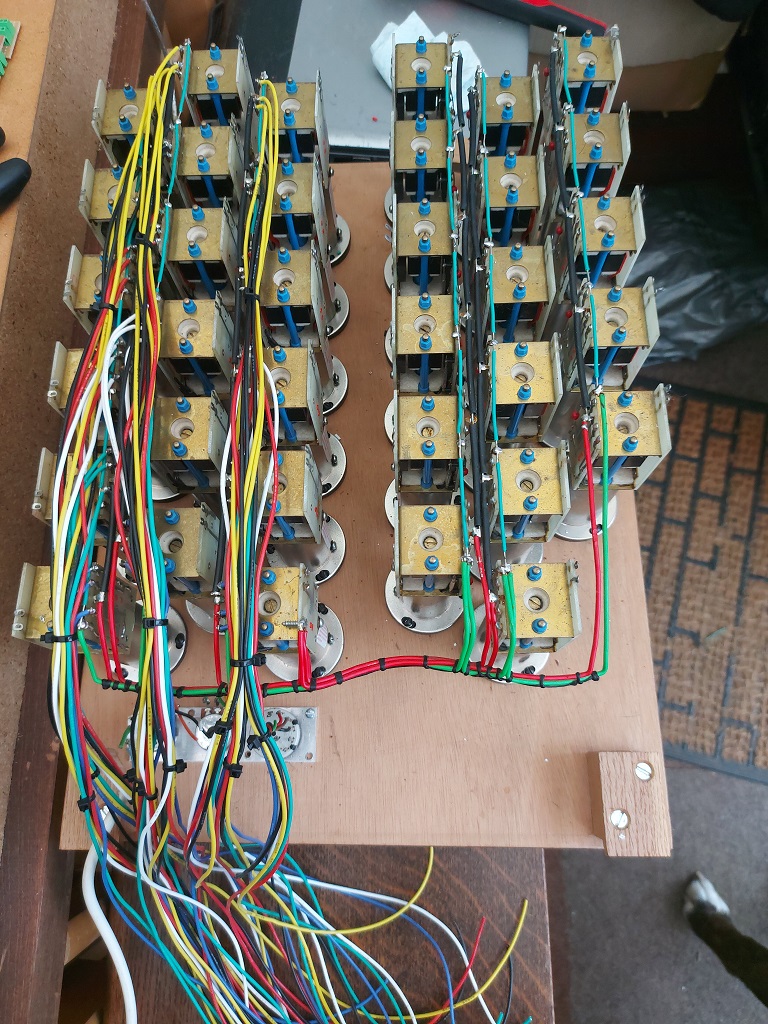
After a bit of playtime, breakfast, more playtime, and several cups of coffee, I made a start on re-wiring the right-hand stop jamb. Here it is, half-way complete. Each stop needs three wires, and I also had to solder a new common +12VDC to each stop. I have now completed 89 of the 140 required solder joints, but it feels like I’ve soldered twice as many. Time for lunch.
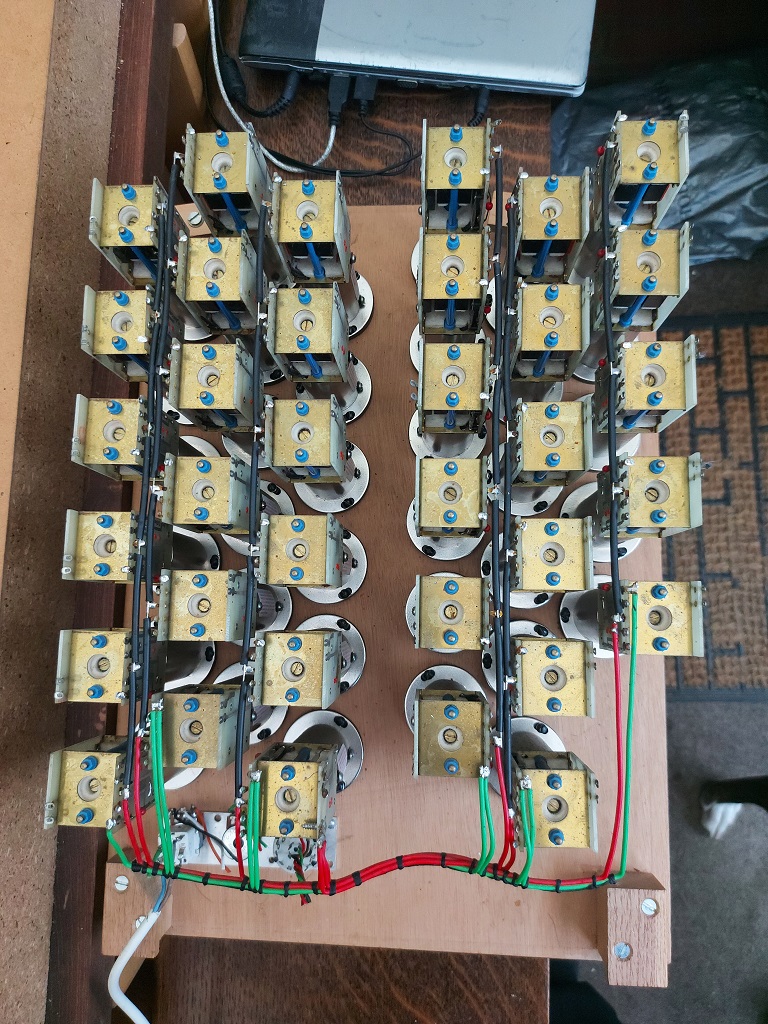
The fog is clearing, and I think I can now see how to connect the drawstops to the MIDI system. The first task was to strip out most of the old wires. The old drawstop configuration pulls up from 0V, but the MIDI interface pulls down to 0V, so I want to use sheathed wire for the common connections. This meant de-soldering some bare-wire 0V connections. I hate de-soldering.
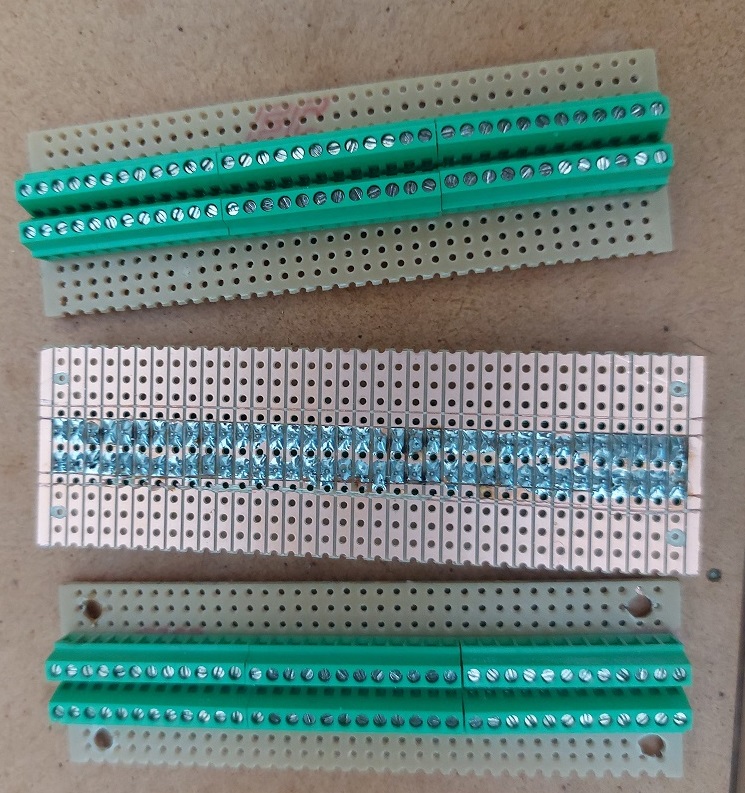
Each drawstop has three connections: two inputs (one for each Stop Action Magnet, or SAM for short), and one output (to send a stop on/off message back to the computer). To make it neater, I have built some connectors out of veroboard. My first veroboard work, and I’m moderately pleased with myself. Don’t spoil it for me.
I’m waiting for some more wire (oh my, I have used so much wire) to arrive. Until then I may have to do other things, like tidying the garden and ironing shirts. One of the tell-tale signs of middle age is getting unreasonably excited with one’s purchase of a new iron. Well, I have a new iron, and it’s great. And I don’t care.
Twice in one day. That doesn’t happen often. Anyway, here are some pictures to brighten your dreary December afternoon. Readers who have any tendency towards obsessive tidiness should look away now.
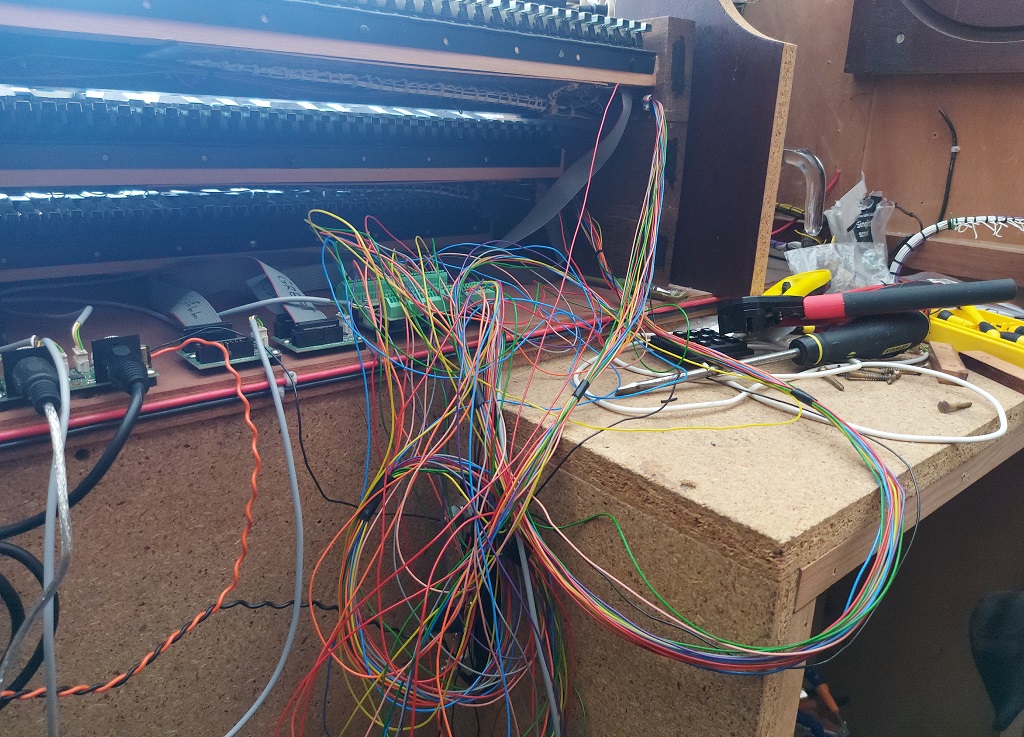
This nest of vipers is where the thumb pistons are connected to the MIDI hardware. I need to trim the wires, but the experience of wiring the pistons up was so traumatic that I don’t want to trim to length until I’m absolutely certain that I won’t need to move anything.
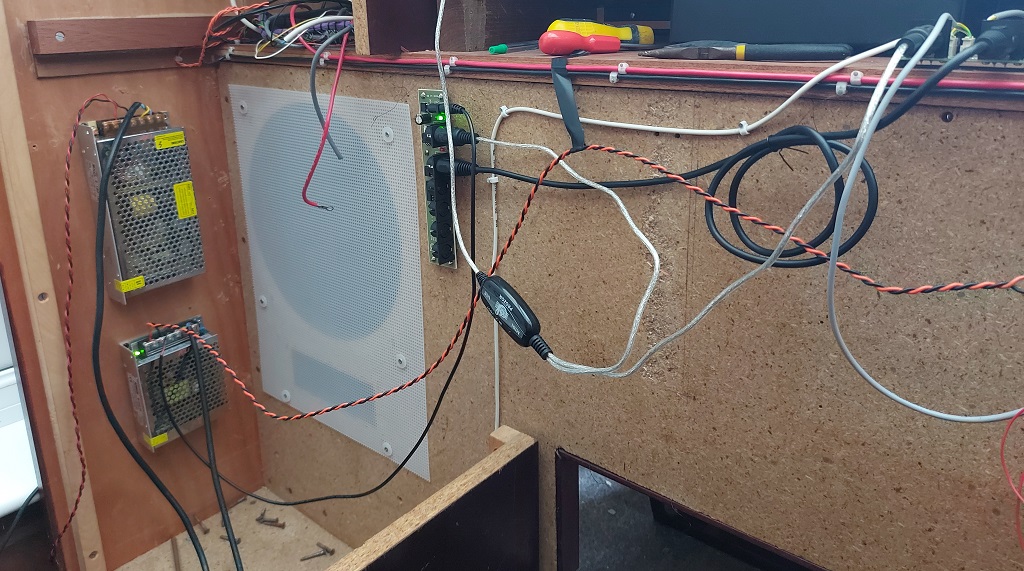
Meanwhile, on the other side of the console, you can see the temporary 18VDC (top) and 12VDC power supplies, and the MIDI splitter (from midiboutique.com), the purpose of which will become clear eventually.
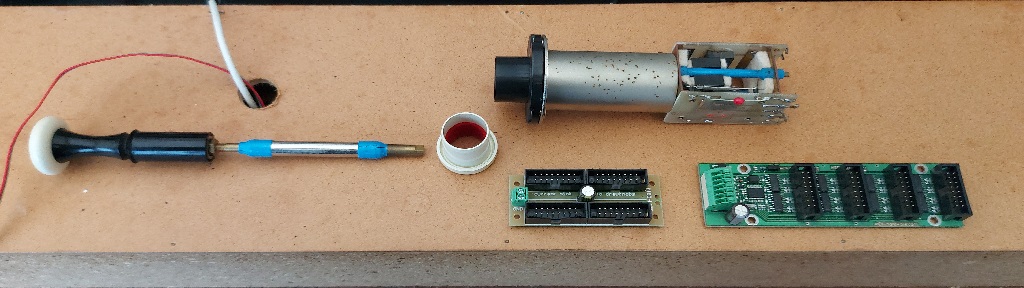
Finally, for anyone wondering what a drawstop looks like with its clothes off, I hope this satisfies you. The boards on the bottom right are the MIDI interface, with each controller board (right) driving up to 32 stops.
Just a quick update, pending another one before Christmas with some piccies.
David popped over a few weeks ago with the newly-sliced right-hand (right-foot?) piston moulding. It was a perfect fit, and has been whisked away again for finishing. I will lose one toe piston, but that won’t kill me. Unfortunately David had already scurried away again before I thought to take a photograph. You’ll just have to imagine it.
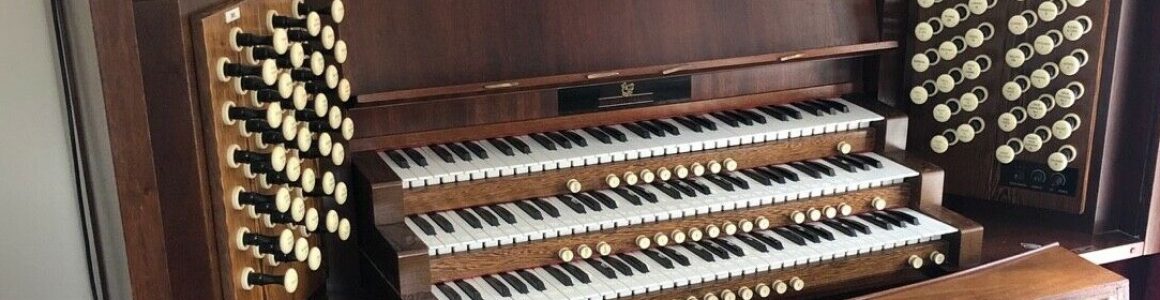
My small brain is presently occupied with thoughts of drawstops. I have 34 Kimber Allen drawstops on the right jamb, and 35 on the left. I took one to pieces and David was kind enough to explain how they work. Each piston requires three connections. The first is the reed switch which turns a rank on or off and operates just like a thumb piston, except that it magnetic rather than kinetic. The other two connections drive the Stop Action Magnets (SAMs) which pull the stop out or push it in, turning the reed switch on or off. I have purchased a cheap-and-cheerful +18VDC PSU to power the electromagnets, which need a bit more welly than everything else.
The SAMs are activated, ultimately, by MIDI messages sent from the computer. This requires two discrete bits of magic: firstly to convert the MIDI message into an electrical signal, and secondly to relay the +12VDC electrical signal to the +18VDC SAM circuit. It’s all a bit confusing.
On current form, I’m expecting rains of frogs in 2022.
Almost nothing done on the organ in the last twelve months, due to the pandemic, and both my work commitments and David’s. The project sputtered into life again last weekend when David popped over (yes! people! in the house!) to re-re-re-measure the toe piston mouldings before cutting them. We changed our minds. Twice. He has gone away now to apply the saw, but I’m trying not to think about it. Hopefully that will be back in a few weeks and I can get on with the build.
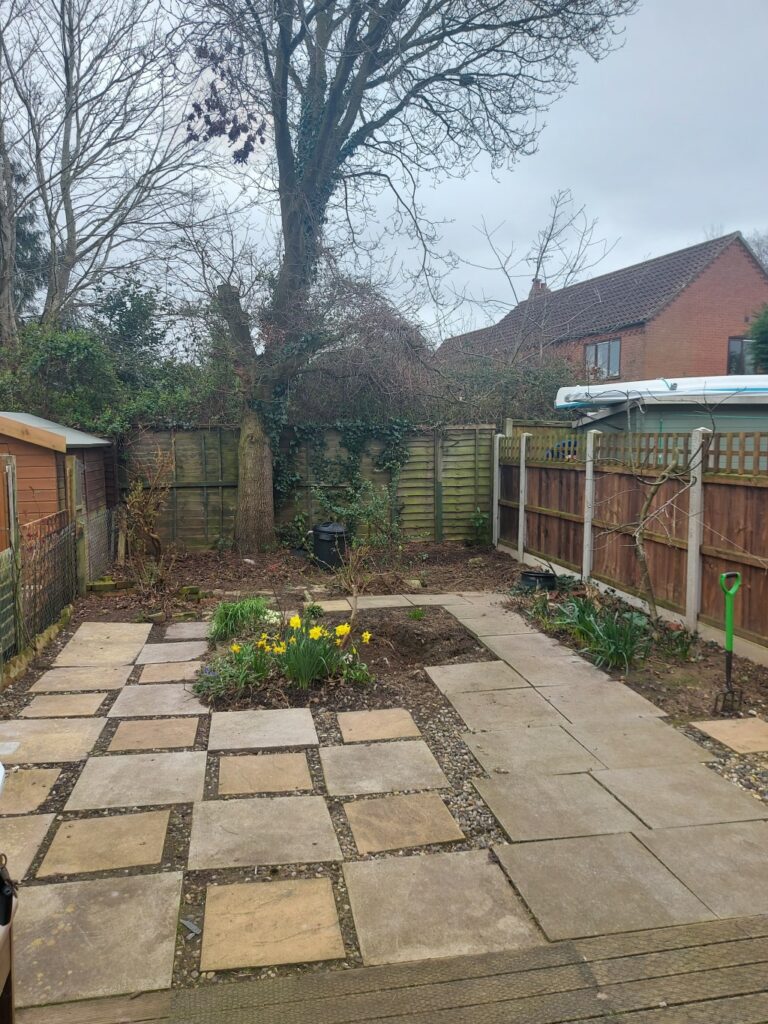
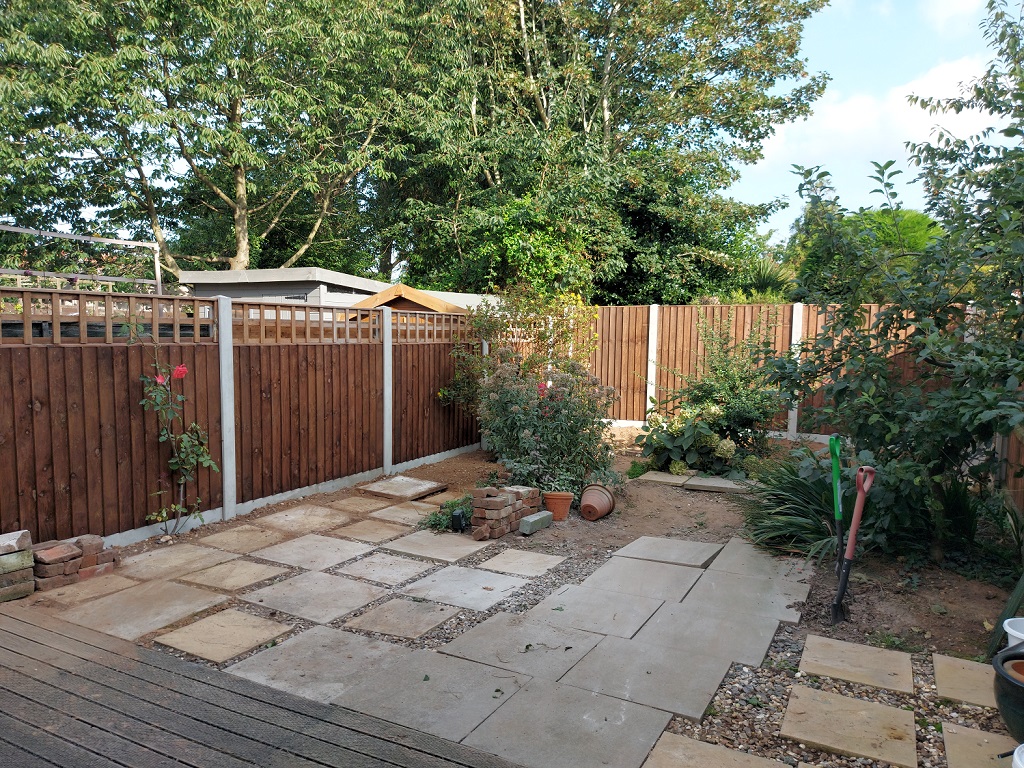
I also removed paid someone to remove the inconvenient oak tree and got a new fence. It’s probably a mark of my advancing age that I am strangely proud of having a new fence, but I’m trying not to think about that, either. Anyway, it’s nice to have it finally erected because I was in perpetual fear of the dog escaping through the enormous holes in the old one, and also because now the fence is in place I can finally start putting things into the garden, rather than taking things out of it. I planted a couple of climbing roses at the side of the house, which appear to have settled in nicely. No major plans for the house interior for the rest of this year, apart from some pre-painting prep work after removing the ghastly wallpaper from the lounge and fitting the new lounge radiator. Next year will hopefully be a bit more exciting.
(or, to be read in a very broad Glaswegian accent: 2020 can git intae tha sea)
So the blog has been rather quiet of late. Not to worry since as far as I know only about four people read it apart from myself. Nevertheless, I feel that I owe it to my patient readers to provide an end of year update. And to my memory, which has turned middle-aged: I don’t have a problem remembering things, it’s just that there is now so much stuff in my head that it is becoming rather cluttered in there.
There have been no further updates on the organ front since the last post, other than that I am now running GrandOrgue on an elderly laptop, attached to not-totally-awful speakers. I am running the Piteå School of Music sample set by Lars Palo. This organ is situated in a school in the north end of Sweden, and is quite beautiful to hear. A three-manual instrument, it has an elegantly simple tonal palette which is a joy to play. I’m currently hacking away at some bits of Bach which I haven’t played in nearly 20 years. The neighbours are very forgiving.
David has made some attempts to visit and make some final measurements before cutting off bits of the toe piston moulding, but 2020 hasn’t been a year for social visits, so we haven’t progressed in that area. In addition, I have been rather overwhelmed with work issues and finding all the… interesting… problems in the new house which the seller forgot to mention. Nothing dramatic, just lots of little things which I have had to fix before fixing other things. With all that to occupy me, I haven’t made any progress in wiring up the thumb pistons either. The drawstops require a psu, which is also David’s domain. Still, I have high hopes for 2021.
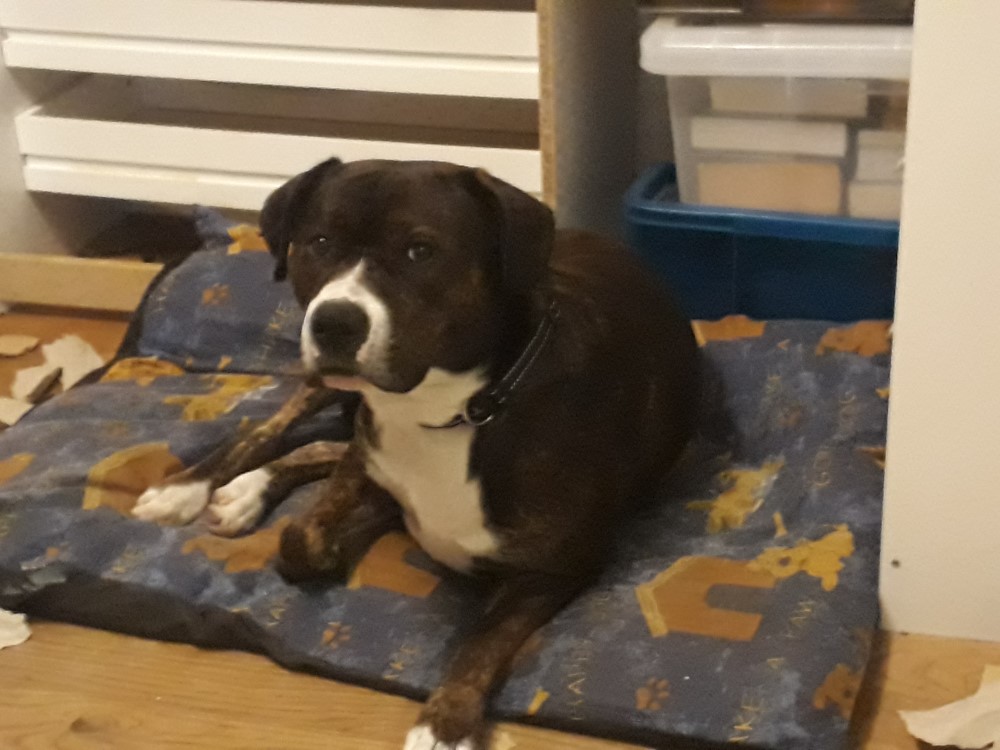
On the dog front, I have lost Bailey and Dewi in unfortunate circumstances which I won’t go into here. I have unexpectedly gained the companionship of Dyson (so named for the way he sucks up frozen peas), an American Bully. At 32kg he is at the smaller end of the dogs who have lived with me. He is quite a character, and only two years old he is very active and bouncy. It is not his fault that he had to be rehomed, and he is the first dog I have owned for many years who has not been “broken” in some way. It is a pleasant change.
Dyson, after living with me for a week – still not sure about things.
I’ve landed myself an interesting secondment into a different department, which I hope will lead to something more permanent. It is very different to what I have been doing for the last eight years, but similar to things I have done before. I hope there is the opportunity to make the secondment permanent, but we shall see. I am very, very busy, but it’s the good sort of busy.
On the whole, 2020 has been one ginormous pair of pants. Here’s to a less-disagreeable 2021.
David came round this afternoon, and various things were discussed. A further check was made to the toe piston moulding before applying the saw, which required the expression shoe assembly to be unscrewed again (there were tears), and instruction was given regarding the screwing-down of the keyboards.
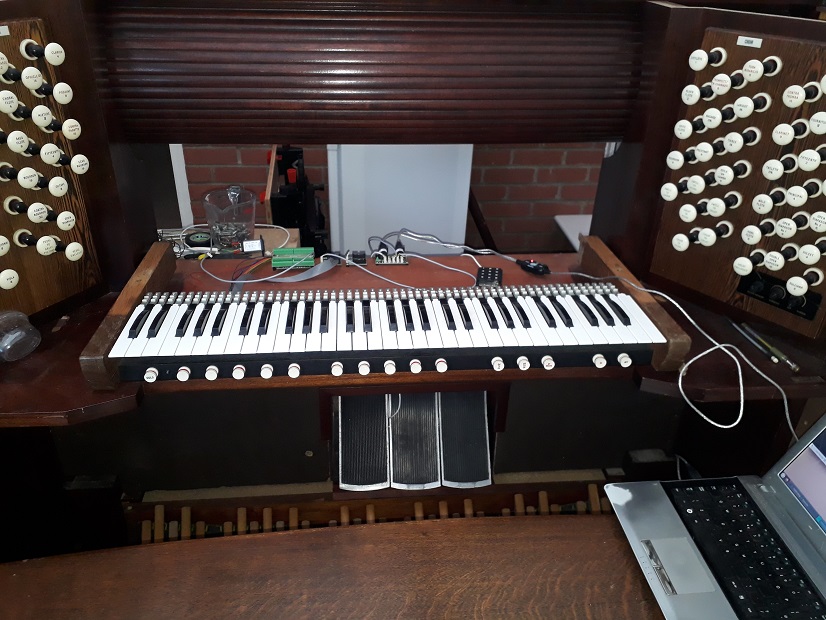
This might not look much, but it represents a major step forward: the choir keyboard has now been permanently affixed to the console and connected to the MIDI nerve-centre
I’ve checked the keyboard, and it works. I’ve also double-checked the pedalboard, and discovered that pot #2 is not as silent as I had hitherto believed. It is perfectly well behaved on its own, but when I start playing the pedals, it spits out all manner of random messages. I have done some testing on this, and it would appear that the problem is either the PDS interface board, or (more likely) the wire. I have a couple of alternative solutions to think about, both of which involve butchering a CAT5 patch cable.
Apart from deciding on the best way forward for the pots, the plan for the rest of this weekend, or at least for the next several days, is to secure all the manuals together and connect them up. This will allow me to finally get some sound out of the console, via the laptop. There won’t be any more progress beyond this until some time in July, as I have to fit in with Norwich Organs’ other commitments. At least I will be able to do some left-hand-and-pedals practice.
Faced with a variety of alternatives to resolve the shouty potentiometer, I opted for the simplest and least invasive first. Wrap a loop of wire around the exposed cable, and attach both ends to GND.
Result: silence.
I’ve no idea why the interference chose this wire and not the other two, but I’ll put that down to magic.
This weekend has been given over to wiring up the pedalboard and expression shoes. It should also have been given over to cutting the grass, but that wasn’t nearly as interesting although it may have proved less frustrating.
The first vexation came when I connected the pedal MIDI nerve to the MIDI central nervous system and plugged that into the laptop to sniff the MIDI messages. The first seven pedals were fine, but the eighth was silent. The next seven were also fine, and the eighth was silent. This pattern was repeated a third time, and then the last eight notes were completely mute. Nary a message issued forth. This was the cue for much poking and prodding with a multimeter, discussions with people who are more knowledgable than I about such matters, an email to Roman at midi-hardware.com, and much stomping around in a foul temper by me. Roman replied with an obvious question: was the PDS module correctly seated on the header pins of the REED32 module? ‘What?’ I asked myself. ‘What a ridiculous question. Of course it is. I’m not stupid.’ Still wearing my stompy boots, off I went to check again before penning a scornful reply.
<pause>
The PDS module was not correctly seated: in fact it was out by a pin. Correcting this embarrassing error proved that the pedals were, in fact, all working perfectly. Somewhat chastened, I spent about half an hour crawling around on the floor with a hot soldering iron in one hand, wiring the pots up to the cable. That was fun. Then back to testing, to discover that, while the first and third (swell and solo) shoes work perfectly, the middle (choir) shoe is generating spurious messages on average once every fifteen seconds. I think that this is down to interference, and I have to try and wrap some additional earth wires around the bare wiper wires tomorrow, which will hopefully solve the problem. If it doesn’t, it has been suggested to me by a beermat that some cat 5 network cable would be even better and have superior shielding ability over such a short (1 metre) run of cable. That’s plan B.
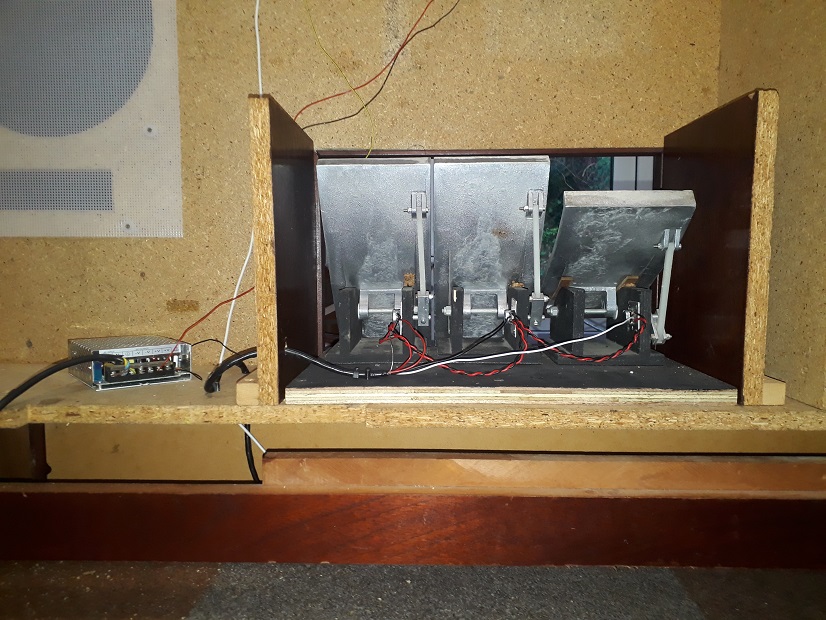
Today’s photographs are the fully wired expression shoes from behind, and the organ console with the pedalboard attached, possibly for the first time in several years. Dewi thought I was photographing him, and wouldn’t stay out of the way.
Once the problem of the interference is solved, I’m somewhat at a loss to proceed further, until I get some hardwood to fill in the gaps on either side of the keyboard, or the toe pistons – both of which David is currently working on.
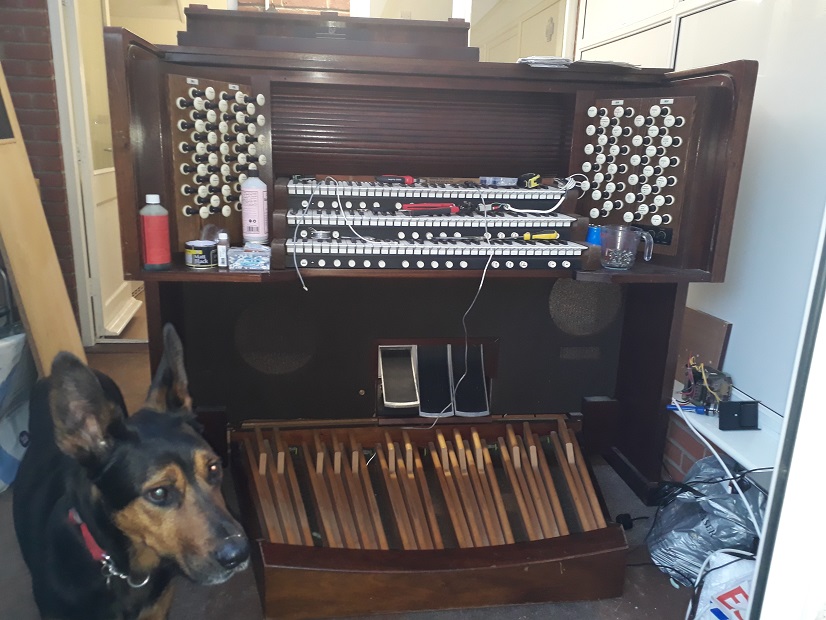
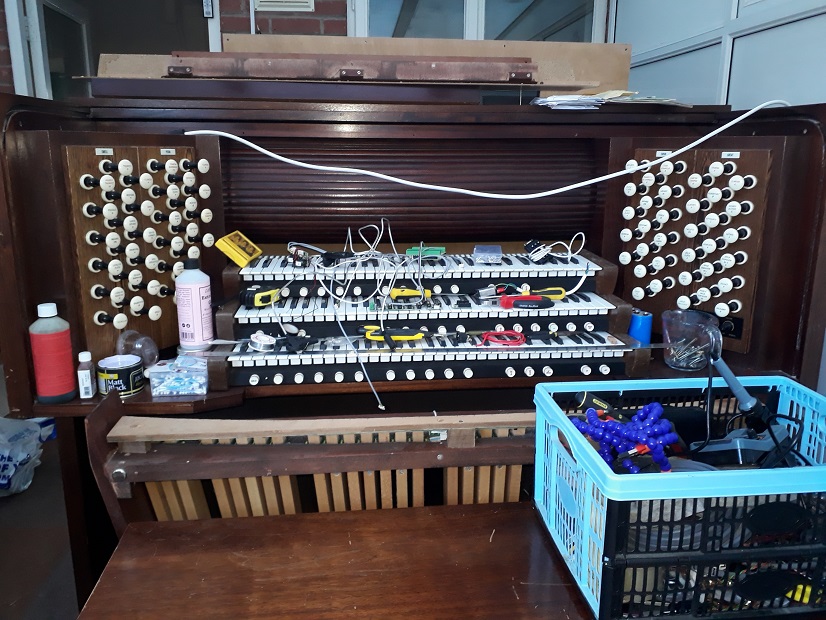
Without much comment, anyway. This is what the console looks like at the moment. It is perfectly organised, and I know the location and purpose of everything on it. Compulsively tidy viewers may wish to look away now.
This website stores cookies on your computer. These cookies are used to provide a more personalized experience and to track your whereabouts around our website in compliance with the European General Data Protection Regulation. If you decide to to opt-out of any future tracking, a cookie will be setup in your browser to remember this choice for one year.