Replacing the contact assemblies

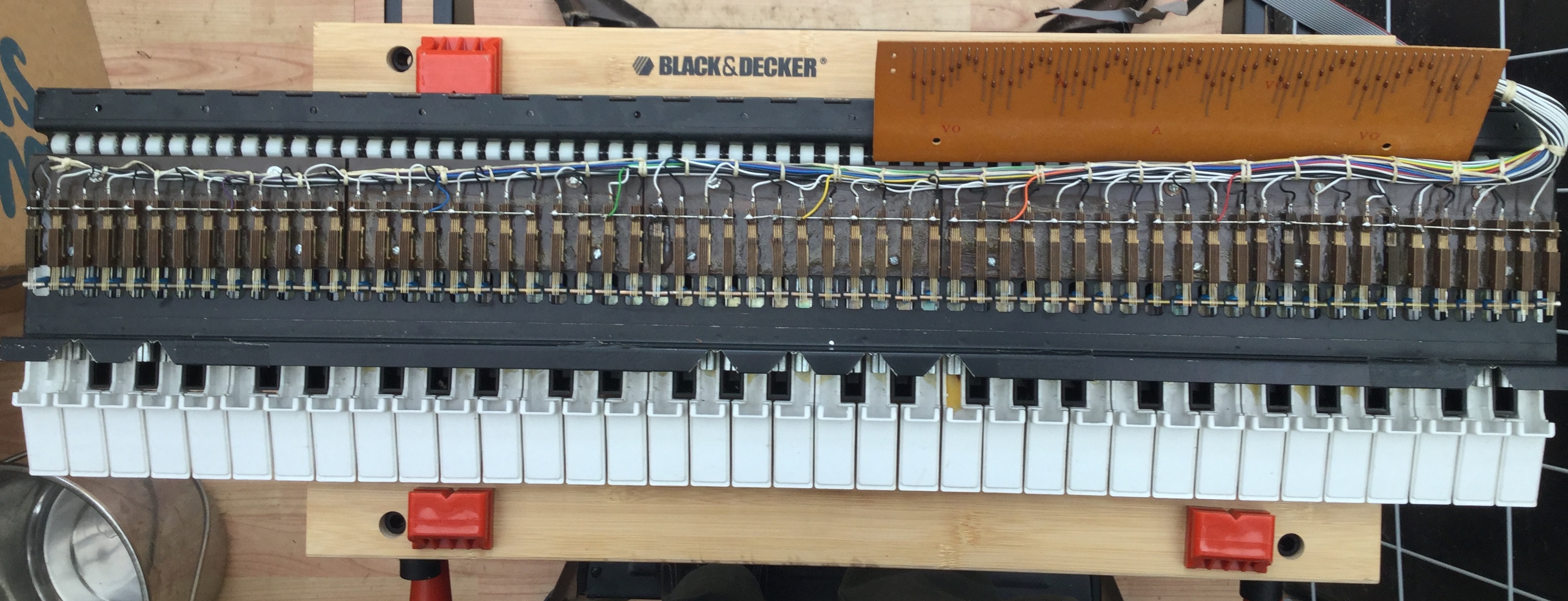
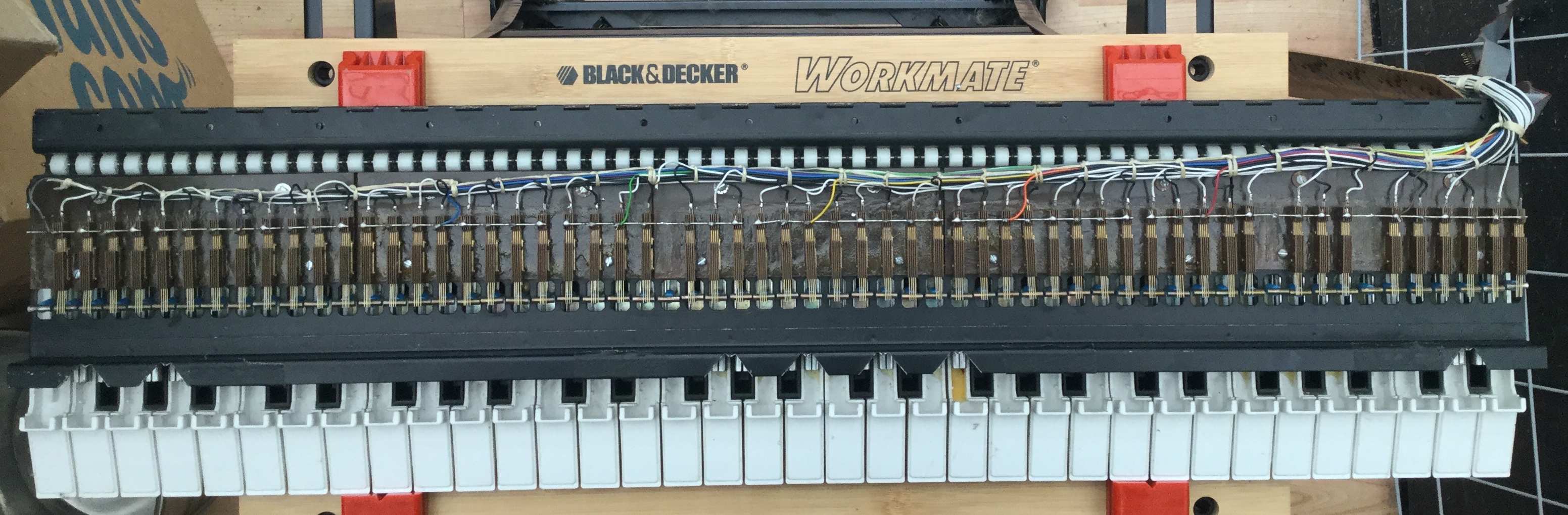
Four contact assemblies on the choir keyboard were beyond straightening.  Fortunately my friendly organ engineer had some spares.  Prising them off was easy, although nerve-wracking, as it required the judicious use of a hammer and chisel.

This photo has been eaten by a grue

Having smoothed the surfaces down and got busy with the Araldite, the replacements are very firmly affixed and soldered.

This photo has been eaten by a grue

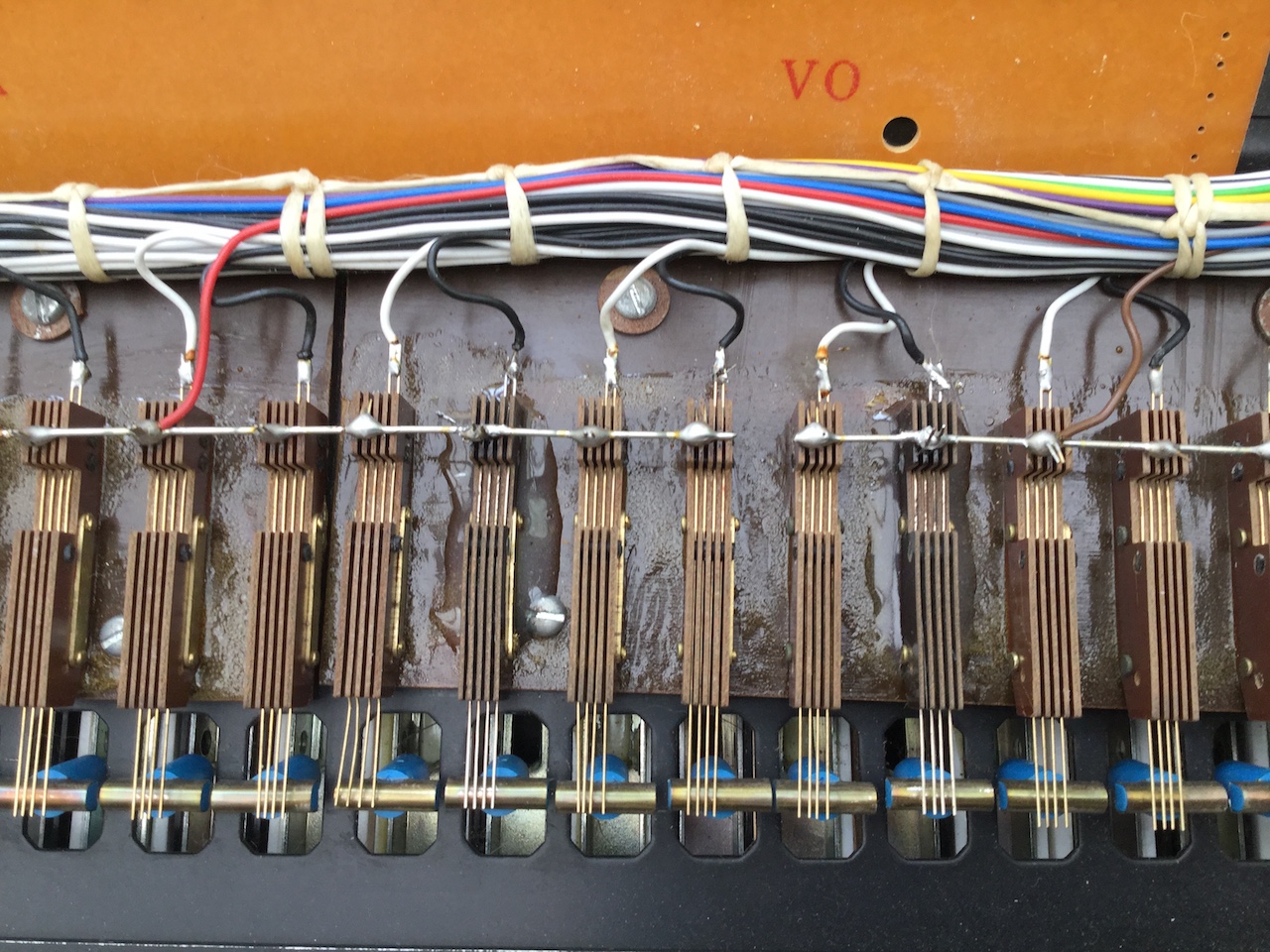
Close-up of the repairs.  Slightly over-araldited, and honesty forces me to admit that it isn’t some of my best soldering, but it is electrically sound, and I won’t see it.  Although I will know it is there, and it will haunt me through every Bach chorale.

This photo has been eaten by a grue

The drawing together of things

On a whim, I went carbooting this afternoon.  Picked up a couple of odds and ends, but most importantly I bought a Dremel.  Only cost £37 and looks hardly used (in fact only two of the bits appear to have been used).  I’ve checked the model and it currently costs £90 from Homebase.  Result.

Today’s work involved repairing the contact assemblies on the choir keyboard, but I’ll post about that when it is finished.  The main event was the reassembling of the swell keyboard in its frame, after cutting out wedges for the additional pistons.

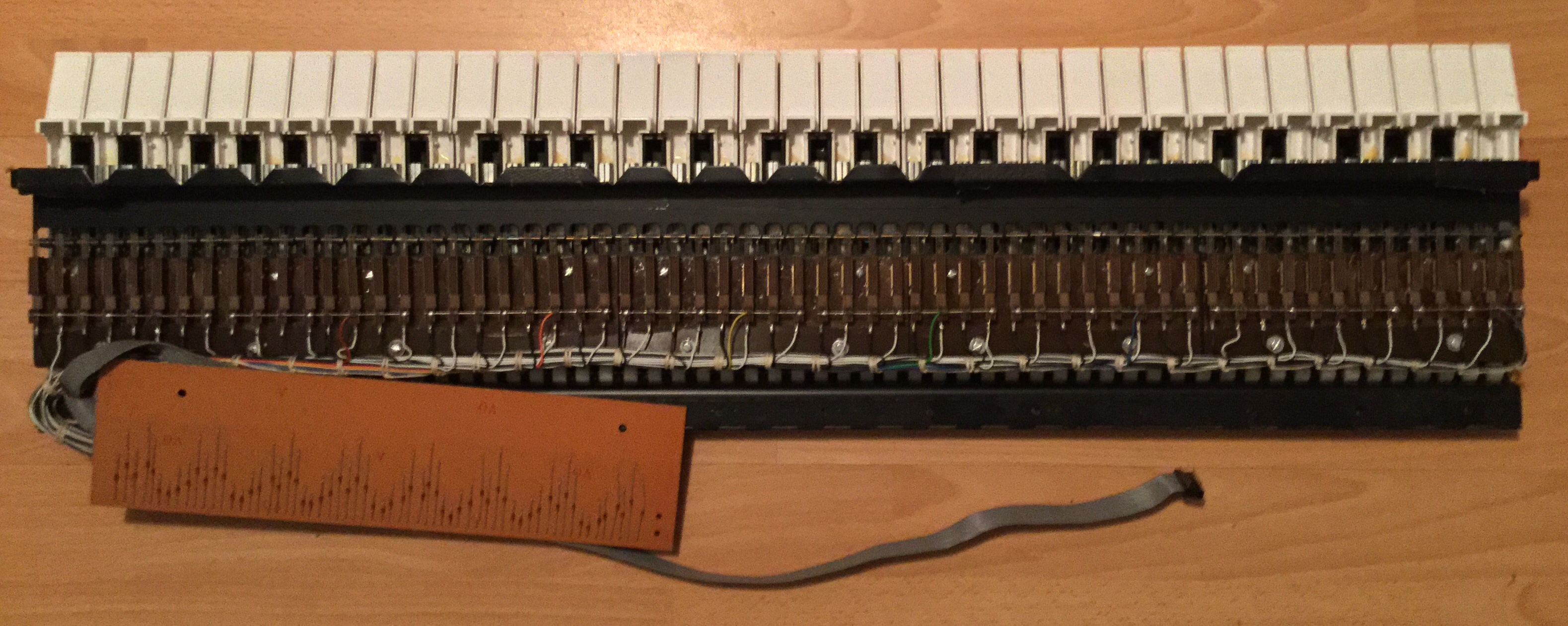
You can see here the additional wedges.  Closer inspection will show you that my wedges are rather less expertly done than the original ones.  I tidied them up afterwards with my Dremel.  That was my justification for buying a new toy.

This photo has been eaten by a grue

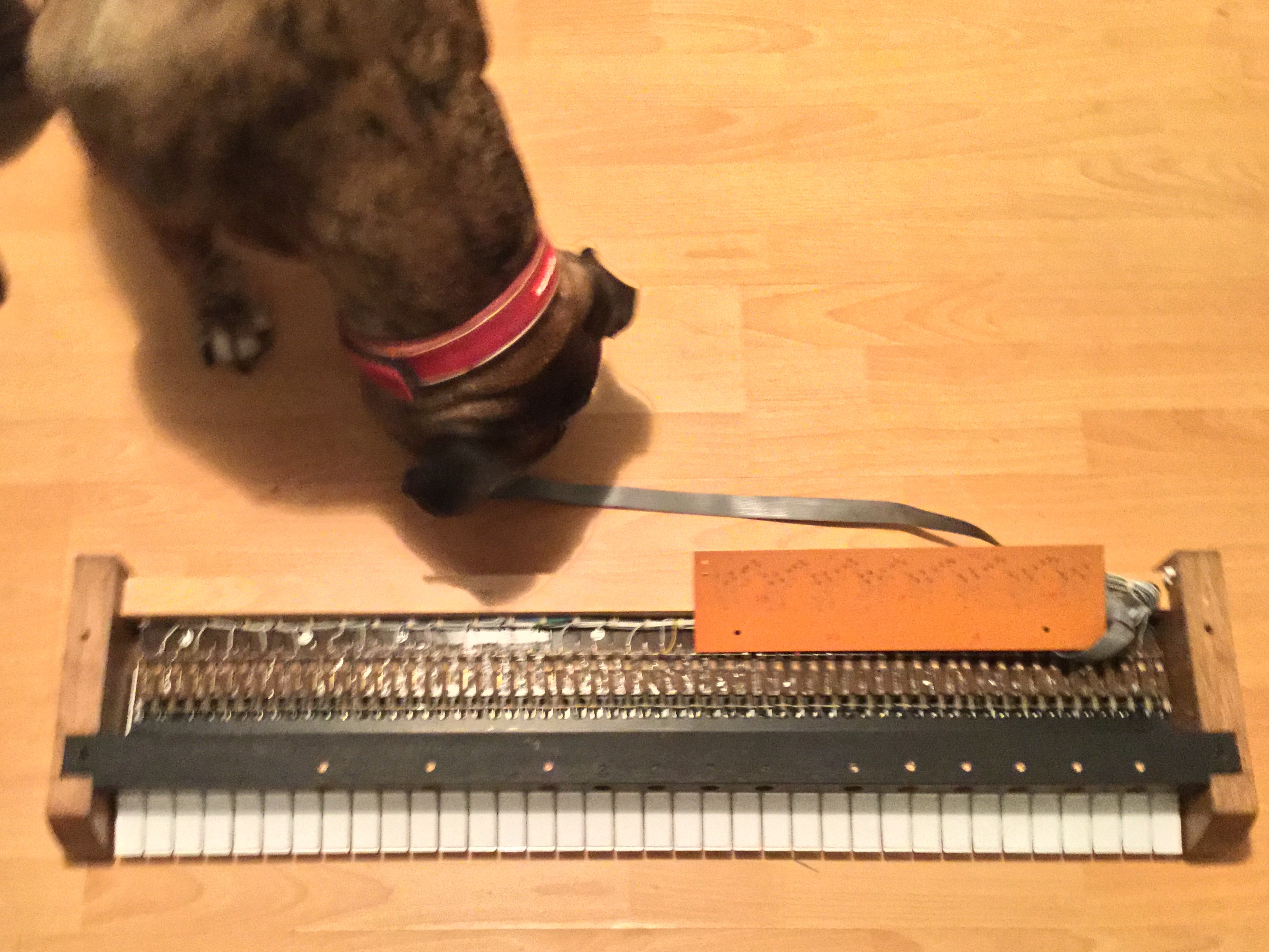
And here is the keyboard fitted into the oak frame.  That took a while; the keyboard sort of guzunder and guzover the crossbars, and it has been a long time since I took it to pieces.  Mia is doing QA.

This photo has been eaten by a grue

I was going to take a photo of the completely assembled keyboard, but the light was poor and my iPad doesn’t have a flash (do any iPads have a flash?).  Tomorrow, maybe.

The next job for this keyboard is to test all the key contacts.  I think that the easiest way to do that is to wait for the MIDI encoder to arrive and plug it in.  Otherwise I’m going to need a third arm to manipulate the continuity tester and the keyboard.


Quickly, before the last post shows me to be a liar

Things have arrived!

I am now in possession of many new things (for various values of ‘new’).

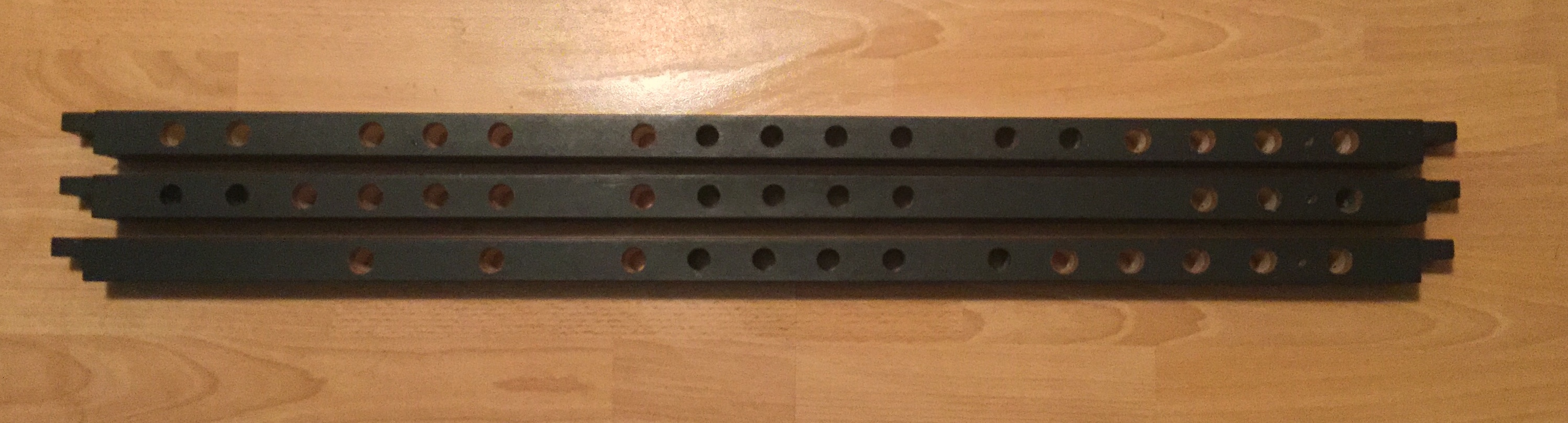
The piston rails have been drilled (see photo; unfortunately I didn’t take a photograph of the pre-drilled rails, but trust me, they didn’t have as many holes in them).

I have enough shiny! new! KA pistons to fill the aforementioned holes. £145 worth of pistons, to be exact.  Actually surprisingly cheap but Mr Norwich Organs had some unused ones in stock.  I’m still thinking about which ones to engrave.

I have some contact assemblies to replace the few damaged ones (and have been given instruction in how to do it).

I have some pedal felt for when I eventually get round to the pedals.

I bought some glue, desoldering braid, and a new pair of snips, since mine have lost their snip.  That was another £19.

The next step is to replace the damaged contact assemblies, which I hope to do on Saturday if the braid arrives.  I will also be ordering my first bit of MIDI kit some time in November.  This must be what progress feels like.

This photo has been eaten by a grue

October is the month of progress

Well I’m back from my holiday, refreshed and poor.  Nevertheless, there will be progress made this month.  At some point in the next couple of weeks I will be collecting the newly-bored piston rails, at which point I can begin to reassemble the keyboards and start testing the contacts (I’ve done a rough test and everything seems fine, but best not to leave anything to chance).  In November, funds permitting, I will be purchasing the first piece of MIDI hardware, which will mean that I will finally be able to get some sound out of the console – I want to thoroughly test the keyboards and pistons before I assemble them into a single block and screw them down.  I also need to get the pistons engraved – still debating on whether to leave the setting pistons blank and only engrave the couplers (as is traditional) or to engrave them all.  Hmm.

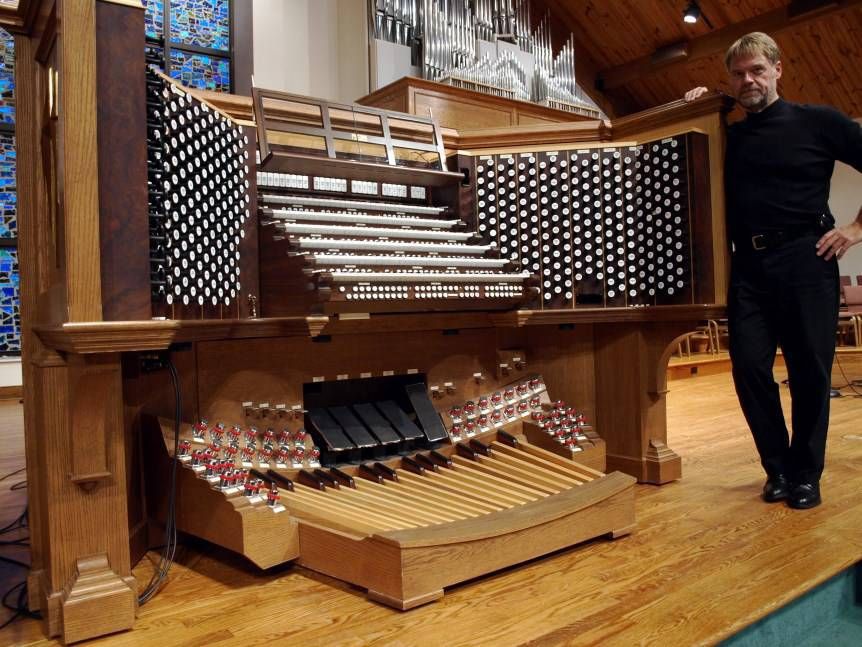
In the meantime, and since this is supposed to be a pictoral record (and I haven’t posted any pictures recently), here are a couple of consoles I am thinking of using for inspiration.  The first is the Harrah Symphonic Organ from Forrest Burdette UMC in Hurricane, West Virginia.  The second is the organ of the Boardwalk Hall Auditorium in Atlantic City, New Jersey.  I’m not sure that any other furniture in the lounge is really necessary…


https://bloximages.newyork1.vip.townnews.com/herald-dispatch.com/content/tncms/assets/v3/editorial/e/72/e72c4412-fc1f-5740-9ccd-1d20cc9c69f9/57be2ba137623.image.jpgImage result for insane organ console

An end to the hiatus approaches

A perfect storm of work (not just mine), illness (not just mine), holidays (not just mine) has led to a regrettable delay in the project.  However, things are once again on the move: the pistons have arrived, and the piston rails will be drilled next week.

I’m off on holiday for the next week-and-a-bit, but I hope that October will see the project return to business as usual.  I am currently unable to entertain, on account of bits of organ console spread all over the house, and it is beginning to bore me.  I yearn to start assembling the keyboard stack and starting to test it.

For’ard!

I try so hard…

The last six weeks have been a blur.  Mia has been in for major surgery, from which she has now fully recovered.  More surgery in July, probably, when her skin is elastic enough.  Poor thing.

Work continues to age me prematurely.  It started with a hard paper round, and has gotten progressively worse since then.  I am withered before my time.

But I now have tangible evidence of progress!  I have received the repaired oak frames for the Choir and Great organ, with the broken screw removed and the hole plugged, and two new fixings bored.  The oak, being at least 20 years old, is as hard as iron, and the job took longer than Mr Norwich Organs expected.  None of this work is visible once the console is assembled, but as I mentioned in an earlier post, the idea of leaving the damage in place was something which the original builder was simply not prepared to countenance.

Next month, which is frighteningly close to becoming this month, I should receive both the re-bored piston rails and sufficient pistons to fill them.  I then need to be a-thinking about what to do next.  My first thought is to buy the MIDI controller so that I can interface with a computer and test the keyboards and pistons before fixing them to the console, however I still have to re-cut the knee-board and rebuild the expression shoe box to take three expression shoes rather than the current two.  And I have not even begun to work on the pedalboard.  This is a point I must ponder most pensively, preparatory to parting with pennies.

I’m probably beyond help.

Getting On With Things

I try to live one day at a time, but just lately it feels as if several days have hit me all at once.

However, progress has been made.  The oak frame for the choir manual will be ready next week, and I will have 43 Kimber Allen pistons next month. I gave serious consideration to Klann pistons, and the salesperson from Klann was extremely helpful.  I like the Klann piston style, which is essentially the European style, and somewhat cheaper than Kimber Allen.  In the end I settled for KA on the basis that it looks “more English”.  I think I would choose Klann if I were building the console from scratch, but since I’m building this organ into an existing English console, with English keyboards, and intend to have an English organ as my primary sample set, I feel that the KA style would be more harmonious.

the next job is to get the holes drilled in the piston rails, and hopefully next month I will be able to assemble the keyboard stack.  I’m getting to the point where I might actually start looking at midi interfaces.

Mia is off for surgery next week to remove the nasty mammary tumours.  Prognosis is excellent, but the operation is a big one.  Poor little puppy.  (She’s 7 years old and weighs 40kg, but she’s always a puppy to me.)

I ate’n’t dead.

Still here.  Meeting myself coming back at the moment, but hopefully will have time (and money!) to spend on more bits in March.

The Great Saga of the Pistons goes on.  Exploring another option, about which more later if it amounts to anything.

This isn’t a piston, either

Rumours of my demise have been greatly exaggerated.  I have, however, been even more busy this month than I predicted.  February isn’t looking much better either.
This photo has been eaten by a grue

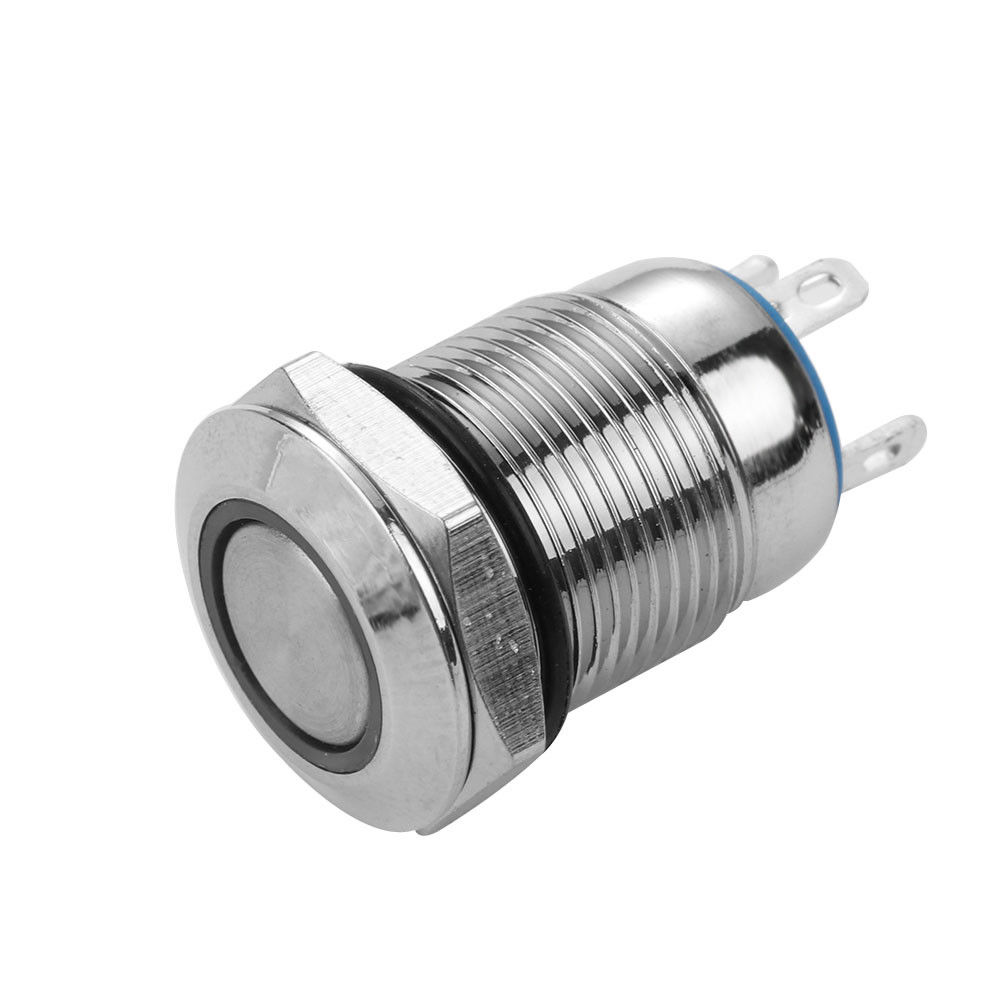
The second switch arrived earlier this month.  It is similar, but superior, to the first, in that it has a silent action.  There are two drawbacks.  Firstly, the button part in the centre is somewhat smaller than is comfortable; and secondly, the shiny new metal looks entirely out of place on the old console.  The first problem could be addressed by using the 19mm switch instead of the 16mm one, but the second is obdurate.  Time for Plan C; the nice man from Norwich Organs is looking for 40 Kimber Allen pistons, which he believes may be in a box in the garage (along with half the clutter in the universe).

Meanwhile, the oak frame of the choir manual has the broken-off end of a screw in it.  I suggested that, since it would be completely covered by the frame of the great manual, I could simply drill another hole for a fixing screw.  This was met with a shocked and mildly outraged, “But I would know it was there!”  Not willing to argue with a craftsman, I rendered up the frame for a quick repair job.

Hopefully I will be able to do something on the project in February.  Once I have confirmation that I have the requisite amount of Kimber Allen pistons, I can at least send the piston rails off for drilling.  Beyond that, I hope that I can start buying some MIDI components in March.

Dogs are doing very well, and have become fast friends.  They now go everywhere joined at the hip, and if one of them has to go out alone for a trip to the vet, the other one sits in the middle of the lounge and sulks.
Next Page » « Previous Page